How to Validate Your SaaS Idea Before Wasting 6 Months Building the Wrong Product
Discover the proven framework to validate your SaaS idea in weeks, not months. Learn how to test assumptions, talk to customers, and avoid costly mistakes before launch

How to Validate Your SaaS Idea Before Wasting 6 Months Building the Wrong Product
Every SaaS founder has been there: You have an idea that feels revolutionary. You can see it clearly in your mind. Your friends think it's brilliant. So you dive in, assemble a team, and start building.
Six months later, you launch to crickets.
The features are polished. The code is clean. But nobody wants what you built.
The problem wasn't execution—it was validation. You built a solution to a problem that either doesn't exist or isn't painful enough for people to pay for.
The good news? Validation doesn't have to be expensive or time-consuming. With a structured approach and the right tools, you can test whether your SaaS idea has real market potential in 4-6 weeks, not months of blind development.
What You Will Learn
- The 5-step validation framework that separates viable SaaS ideas from dead-ends
- How to talk to real customers without leading questions or bias
- Which assumptions are worth testing (and which to ignore)
- Tools and tactics to gather market evidence quickly
- How to recognize the warning signs that your idea needs pivoting
- The single metric that tells you if you should keep building or step back
Section 1: Why Most SaaS Ideas Fail at Launch (And How Validation Prevents It)
The statistics are brutal: 92% of startups fail. While many reasons contribute to failure, the most common culprit is building something nobody wants.
Here's the disconnect: Your intuition feels right. You've identified a gap in the market. You've seen the inefficiency yourself. But intuition isn't evidence.
What separates successful SaaS founders from those who burn through savings is a simple habit: they validate assumptions before investing heavily in development.
Validation answers these critical questions:
- Do real customers actually care about this problem?
- How much would they pay to solve it?
- Who is the specific person (not the vague "everyone") who would use this?
- Does your solution solve the problem better than existing alternatives?
Without validation, you're essentially gambling. With it, you're making an informed bet. The difference in odds is enormous.
Section 2: The 5-Step SaaS Validation Framework
Step 1: Define Your Core Assumption
Before you talk to anyone, clarify the single riskiest assumption about your idea. This is the one thing that, if false, means your product won't succeed.
For example:
- "Freelance consultants spend more than 10 hours/week managing client communications."
- "E-commerce brands manually reconcile inventory across 3+ sales channels."
- "Mid-market manufacturers struggle with production scheduling."
Your core assumption should be specific, measurable, and critical to your business model. It's not "people want a better X"—it's a concrete claim about behavior or pain.
Write it down. You'll test this first.
Step 2: Identify and Interview Real Customers
This is where most founders fail. They ask leading questions or survey people who vaguely fit their target market—and get useless feedback.
Instead:
-
Define your ideal customer profile (ICP) precisely. Don't say "small businesses." Say "SaaS founders with 5-50 employees, less than $2M ARR, bootstrapped."
-
Find 15-20 people who match your ICP. Use LinkedIn, industry forums, Facebook groups, warm introductions. Quality over quantity.
-
Conduct 30-minute customer interviews. Not surveys. Real conversations.
-
Use the consultative approach. Ask open-ended questions that let them reveal problems, not confirm yours:
- ❌ "Do you spend a lot of time managing clients?"
- ✅ "Walk me through your typical day. Where do you lose the most time?"
-
Listen for emotion and frustration. If they say "I wish someone made a tool for X," that's gold. If they say "yeah, that could be useful," that's likely noise.
Step 3: Validate Willingness to Pay
A problem isn't viable for a SaaS business if customers won't pay to solve it.
During interviews, ask directly:
- "How much would you pay for a tool that solved this for you?"
- "What's your annual software budget for this category?"
- "Would you personally purchase this if it existed?"
Don't accept vague answers. Push for specificity. Real buying intent sounds like: "I'd absolutely pay $500/month for that," not "maybe $100, I'm not sure."
Also pay attention to what they're currently spending to solve the problem (even if manually). If they're spending $10k/year on workarounds, they'll likely pay for a $200/month SaaS solution.
Step 4: Identify Your Competitive Landscape
Your validation isn't just about the problem existing—it's about your solution being better than alternatives.
For each interview, ask: "How do you currently solve this?" Then research their answers.
Your competition isn't just direct SaaS competitors. It's:
- Manual workarounds (spreadsheets, email)
- Existing software they repurpose
- Partially-manual services
- Doing nothing (procrastination)
For your idea to win, customers must see clear advantages over these alternatives. What do you do that they don't?
Step 5: Define Your Success Metric
Before you conclude validation, decide: What percentage of customers need to express strong buying intent for you to move forward?
A common benchmark: If 3+ out of 5 early customers say they'd definitely buy and name a price, move forward.
If you're seeing lukewarm interest or low willingness-to-pay, it's time to pivot or abandon.
Section 3: Tools, Tips & Best Practices
Tools That Speed Up Validation
For Finding Customers:
- LinkedIn Sales Navigator – Filter by company size, role, industry
- Reddit, Facebook Groups, Slack communities – Real people discussing real problems
- Indie Hackers, Product Hunt – Communities of founders and early adopters
- Warm intros – Ask friends/mentors if they know people in your target market (highest conversion)
For Conducting Interviews:
- Calendly – Schedule calls without back-and-forth emails
- Otter.ai or Fireflies – Transcribe interviews automatically (so you take notes, not worry about missing details)
For Tracking Findings:
- Notion or Airtable – Log interview notes, quotes, and patterns
- Typeform or Google Forms – Quick surveys to validate with larger groups after interviews
Pro Tips for Faster Validation
-
Set a time limit. Give yourself 4-6 weeks max. This forces focused decision-making.
-
Interview in batches. Don't do one interview, reflect for a week, then do another. Do 3-4 per week.
-
Look for patterns, not individual opinions. One person saying "I'd use that" doesn't validate your idea. Three independent customers naming the same problem and expressing willingness to pay—that validates.
-
Test your messaging early. When describing your solution, watch which words make people's eyes light up. That's your positioning.
-
Be willing to pivot. If customers repeatedly mention a different problem that's more urgent, that's your real opportunity. Listen.
And here's the key insight: Most founders try to validate entirely manually—spreadsheets, scattered notes, memory. This is inefficient and prone to bias. Tools like ReadyToRelease.online streamline this process by helping you structure your validation research, track assumptions, and synthesize customer feedback into actionable insights. Rather than juggling interviews, notes, and assumptions across five platforms, you can centralize your validation evidence in one place, making patterns obvious and decisions faster.
Section 4: Case Study – How Maya Validated Her Scheduling SaaS in 5 Weeks
Meet Maya, a former operations manager who identified a problem: Agency account managers waste 5+ hours weekly scheduling client meetings across timezones.
Week 1-2: Define & Interview Maya defined her ICP: "Operations managers at agencies with 10-50 people, managing 20+ clients." She reached out to 12 people on LinkedIn (cold but personalized). Got 8 interviews scheduled.
Key finding: Every single person mentioned "timezone scheduling" as a pain point. They all used a mix of Calendly, Google Calendar, and Asana—pieced together, inefficient.
Week 3: Validate Willingness to Pay Maya asked directly: "What would you pay for a tool that solved this automatically?"
Six out of eight said "$200-400/month." Two said they weren't sure. Maya marked the uncertain ones as "maybes."
Week 4: Competitive Analysis She mapped out: Calendly (scheduling only), Asana (all-in-one but bad at timezones), Slack integrations (clunky). Nobody solved the specific problem cleanly.
Week 5: Decision Maya had her answer: Real pain, willingness to pay, weak competitive landscape, specific market. She started building.
Result: 18 months later, Maya's product has $40k MRR with 60+ paying customers, all from the same ICP. Validation works.
Section 5: Why ReadyToRelease.online Is Your Validation Partner
Here's the reality: Validation requires structure. You need to systematically track assumptions, interview findings, competitive research, and customer signals. Without a framework, you're juggling information in your head or across scattered documents, and bias creeps in.
ReadyToRelease.online is built specifically for this moment. It helps you:
Organize Your Validation Research
- Centralize all customer interview notes, quotes, and insights
- Track which assumptions you've tested and what you learned
- See patterns emerge from multiple interviews without manual analysis
Stay Objective
- Document customer feedback before you interpret it
- Create a clear audit trail of evidence (this matters for investor pitches, too)
- Avoid confirmation bias by logging both supporting and contradicting data
Make Faster Decisions
- Visual dashboards showing validation progress across your key assumptions
- Checklists that guide you through the validation process
- Clear go/no-go criteria so you know when you've gathered enough evidence
Build Investor-Ready Documentation
- Exportable validation reports that show rigorous customer research (investors love this)
- Evidence of market demand and willingness to pay
- Proof that you've de-risked the core assumptions
Rather than spending 4-6 weeks juggling spreadsheets and trying to remember what 15 customers told you, ReadyToRelease.online helps you run a professional validation sprint that produces clear, defensible conclusions in half the time.
→ Start Validating Your SaaS Idea with ReadyToRelease.online ← (Free 14-day trial, no credit card required)
Conclusion
The difference between SaaS founders who succeed and those who fail often isn't talent or work ethic—it's timing of validation.
Successful founders validate early and often. They invest 4-6 weeks in rigorous customer research before they invest months in development. This drastically increases the odds that they'll build something people actually want.
Your action plan:
- This week: Write down your core assumption (the one thing that must be true)
- Next week: Reach out to 15 potential customers and schedule interviews
- Week 3-4: Conduct interviews, look for patterns
- Week 5: Analyze and decide: build, pivot, or abandon?
Use ReadyToRelease.online to keep your research organized, objective, and actionable throughout.
Your first customer interview could change everything. Get started this week.
→ Try ReadyToRelease.online Free for 14 Days – No credit card required. Start validating your SaaS idea today.
Related Resources
- The Lean Startup Methodology: How to Build Products Customers Actually Want – A deep dive into Eric Ries' framework
- How to Write Customer Interview Questions That Actually Reveal Problems – Template and best practices
- The Product-Market Fit Checklist: 10 Signs Your SaaS Is Ready to Scale – Know when you've achieved PMF
- Competitive Analysis for SaaS: Research Framework & Tools – How to map your market landscape
- From Idea to MVP: The 12-Week Validation & Build Plan – Timeline and milestones
Found this helpful? Share it:
Get SaaS insights in your inbox
Join 500+ founders getting weekly tips on market research, competitor analysis, and SaaS validation.
Ready to launch your SaaS idea?
Get comprehensive market research and competitor analysis in minutes. Skip weeks of manual research and start building faster.
Related Articles
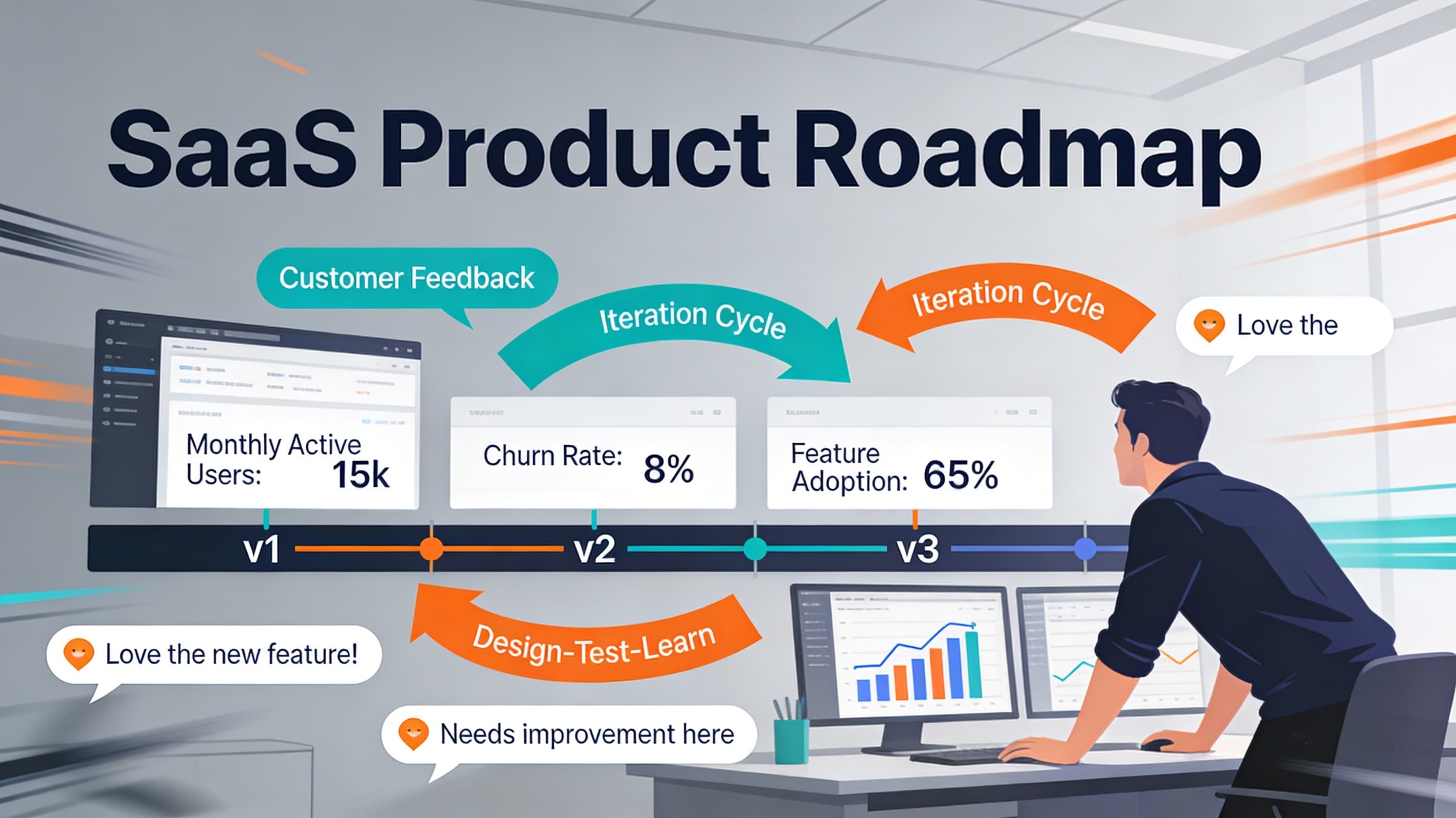
The SaaS Launch Playbook: 7 Proven Strategies to Get Your First 100 Paying Customers
Master the SaaS launch process. Learn 7 battle-tested strategies to acquire your first 100 paying customers without a massive marketing budget
Read more
How Can Founders Validate a Startup Idea Using Market Data?
Learn how to validate your startup idea with real data using ReadyToRelease — the €9.99 tool that automates market-research with data from Product Hunt, Census, World Bank, Reddit, and Gemini
Read more
How Is Artificial Intelligence Transforming Market Research for Startups?
Discover how AI is reshaping market research for startups. Learn how ReadyToRelease uses AI to create instant, affordable, data-driven reports integrating Product Hunt, Census, and World Bank data
Read more